


Summary
Preventing leader burnout requires more than individual stress management. New research shows how change fatigue, limited resources, and low trust drain leaders' energy, even as many remain in their roles. By strengthening delegation, conflict resolution, trust, and change readiness, organizations can help leaders maintain their well-being and perform sustainably.
Burnout among leaders is becoming a growing threat to organizational performance. As leaders navigate constant change, mounting expectations, and increasingly complex responsibilities, many are struggling to maintain the energy they need to lead effectively.
According to DDI's Global Leadership Forecast 2027, nearly one in five leaders (19%) frequently feel "used up" at the end of the workday, a key warning sign of burnout. At the same time, only 17% feel very prepared to anticipate and react to the nature and speed of change.
Yet these depleted leaders aren't necessarily leaving. Many remain in their roles, creating a hidden performance risk as organizations continue to rely on them to make decisions, support their teams, and deliver results through uncertainty.
Preventing leader burnout requires more than helping individuals manage stress. Organizations must address the workplace conditions driving exhaustion while giving leaders the skills, resources, and support they need to perform sustainably. Targeted development, including courses focused on managing workplace burnout, can help leaders recognize warning signs and take steps to manage stress before it becomes overwhelming.
What Is Workplace Burnout?
Burnout is a work phenomenon that’s become so prevalent that the World Health Organization (WHO) recognizes it as an occupational phenomenon resulting from chronic workplace stress that has not been successfully managed. It is characterized by exhaustion, increased mental distance or cynicism toward work, and reduced professional efficacy. Leaders experiencing burnout commonly report:
- Decision fatigue and difficulty concentrating.
- Longer work hours with lower productivity.
- Increased irritability and impatience with team members.
- Decreased enthusiasm and passion for projects that once engaged them.
- Neglecting self-care and personal needs.
- Physical symptoms such as headaches, sleep disturbances, or digestive issues.
Burnout is deeply personal. Yet it stems from systemic workplace issues that organizations must address to prevent long-term damage to their leadership pipeline.
The Impact of Stress and Burnout
Leadership burnout is more than an individual problem. When leaders experience chronic stress and exhaustion, their ability to make decisions, support their teams, and respond to challenges can suffer. And with many depleted leaders staying in their roles, the consequences may be less visible than organizations realize.
Here’s how the impact shows up:
Performance Risk
Exhaustion can make it harder for leaders to identify problems early, remain productive through setbacks, and bring out the best in their teams. DDI's research found that leaders who frequently feel "used up" are 3.9X more likely to learn about issues later than they should have.
Building leaders' readiness for change can help mitigate these performance risks. Leaders who feel very prepared for change are 1.9X more likely to remain consistently productive during unexpected setbacks than those who feel less prepared.
Retention Risk
Burnout doesn't always lead to turnover. New DDI research shows that only 6% of highly stressed leaders intend to leave their organization within the next year, while just 15% have considered leaving their leadership roles to improve their well-being.
Economic uncertainty and job-security concerns may be keeping exhausted leaders in place. While lower turnover may appear reassuring, organizations risk overlooking leaders who are struggling to sustain their performance.
Engagement Risk
Burnout can also undermine the energy and motivation leaders bring to their roles. According to GLF 2027, only 9% of leaders are fully engaged, while half are only somewhat engaged. And the difference matters: Fully engaged leaders are 8.8X more likely to consistently bring out the best in their team members than somewhat engaged leaders.
When leaders lack the energy and engagement to support their teams, the effects can extend well beyond their own experience at work.
What Causes Leaders’ Stress and Burnout?
Leaders are being asked to accomplish more while navigating constant change, limited resources, and growing expectations. These pressures can accumulate over time, leaving leaders with little opportunity to recover before the next challenge arrives. Research points to four workplace factors that can increase burnout risk.
1. Lack of Time
Time scarcity is a critical issue for leaders. According to the Global Leadership Forecast 2025, only 30% of leaders feel they have sufficient time to do their job well. The pressure to perform without enough time leads to:
- Overwork: Leaders extend their work hours at an unsustainable pace, sacrificing their mental and physical well-being.
- Chronic frustration: The mismatch between time and workload creates stress, resentment, and exhaustion.
When leaders have little time to focus on their most important responsibilities, even routine challenges can become overwhelming.
2. Change Fatigue and Pressure to Perform
Constant organizational change is placing new demands on leaders, often without giving them the time or support to adjust. Restructuring, evolving technology, and shifting business priorities require leaders to adapt quickly while still delivering results.
DDI's research found that 73% of leaders feel strong pressure for perfection even when new challenges arise. That creates a difficult contradiction: Leaders are expected to experiment, adapt, and respond to uncertainty, but may feel they have little room for mistakes.
According to DDI's Global Leadership Forecast 2027, the percentage of Gen Z leaders who frequently feel used up at the end of the workday rose from 20.8% to 26.3%, a 5.4-percentage-point increase since the 2025 survey year. With more than one in four Gen Z leaders frequently feeling used up at the end of the workday, exhaustion is becoming an increasingly urgent concern for organizations developing their next generation of leaders.
Organizations can reduce this pressure by clarifying priorities, setting realistic expectations, and preparing leaders to navigate change with greater confidence.
3. Resource and Information Constraints
Leaders often lack the tools and information they need. When they do, they are twice as likely to worry about burnout. This challenge shows up in:
- Decision fatigue: Making high-stakes choices without complete information increases stress and cognitive overload.
- Lower perceived competence: Leaders without the right resources feel less confident in their abilities, a key factor in burnout.
As responsibilities expand and resources become more constrained, leaders may feel pressure to compensate by working longer hours or taking on more themselves. Without adequate support, these short-term adjustments can become unsustainable.
4. Lack of Trust
Trust plays an important role in how leaders experience workplace stress, particularly during periods of uncertainty. DDI's research shows that leaders who don't believe their organization's leadership handles change well are twice as likely to feel "used up" at the end of the workday.
Lack of trust significantly amplifies burnout risk through:
- Psychological insecurity: Leaders who don't trust their organization's direction remain in a state of heightened stress.
- Communication strain: Without trust, leaders must carefully filter their messaging, increasing emotional labor.
- Values conflict: Leaders may struggle to align with decisions they don't believe in, creating moral distress.
When leaders trust how decisions are made and how change is managed, they can spend less energy navigating uncertainty and more energy supporting their teams.
How Do Work Arrangements Affect Leader Stress?
Work arrangements also influence leader stress and burnout, with different patterns emerging based on how and where leaders work, including the following:
Leaders' Own Work Arrangements
According to Global Leadership Forecast 2025, leaders who work onsite report higher stress levels (74%) than hybrid (72%) or remote (66%). Onsite leaders may face more frequent interruptions, interpersonal demands, and pressure to maintain a visible leadership presence throughout the day.
Interestingly, this trend reverses when examining burnout concerns. Hybrid and remote leaders report the highest levels of burnout concern, at 57% and 56% respectively, compared to 52% of in-person leaders.
For hybrid and remote leaders, blurred boundaries between work and personal time, expectations for constant availability, and fewer informal opportunities to connect with colleagues may contribute to these concerns.
Alignment of Manager and Direct Report Work Arrangements
Adding to these challenges, stress levels rise when a leader's work arrangement differs from their manager's.
Global Leadership Forecast 2025 found that remote direct reports with an in-office manager are 2X more likely to be stressed than remote employees whose manager also works virtually. On the other hand, direct reports who work onsite but have a manager who works remotely are 1.4X more likely to be stressed than those whose manager is also onsite.
This pattern stems from communication gaps, mismatched expectations, and a lack of shared context, making it even harder for leaders to manage their workloads.
When managers and direct reports have similar work arrangements, they may find it easier to establish shared expectations and communication rhythms. Regardless of where people work, managers need to create clarity, maintain connections, and provide consistent support to help reduce unnecessary stress.
An Organization's Responsibility
Time scarcity, change fatigue, resource constraints, low trust, and work arrangements all influence leaders' risk of burnout. Together, these factors show why leaders can't address burnout through individual stress management alone. Organizations need to examine the expectations, working conditions, and leadership practices that contribute to exhaustion.
Preventing burnout isn't just about teaching leaders to take breaks. It's about creating work environments where leaders can maintain both their well-being and their effectiveness to drive organizational success.
5 Strategies to Prevent Leader Burnout
Preventing burnout requires organizational change, not just individual resilience. Organizations can take five practical steps to reduce the pressures driving burnout and help leaders sustain their performance:
1. Strengthen Leaders' Delegation Skills
Delegation is one of the most important leadership skills for preventing burnout. According to DDI's Global Leadership Forecast 2025, based on data from 10,796 leaders, delegation is the most important skill in mitigating burnout (80%). This makes it five times more impactful than any other burnout mitigation skill.
Leaders who struggle to delegate often become bottlenecks, carrying excessive workloads that lead to stress and exhaustion.
Effective delegation enables leaders to distribute responsibilities strategically, preventing the overwhelming pile-up of tasks that contribute to burnout. By entrusting team members with appropriate responsibilities, leaders reduce their own stress and foster team development and engagement. This shift transforms leadership from a solo, exhausting effort into a collaborative process.
And yet, according to DDI's assessments of more than 70,000 manager candidates, only 19% are strong in delegation. Delegation is a complex skill that involves a blend of building trust, communicating clearly, and coaching each team member. It can be difficult to master, but it is critical for leaders' success.
Many leaders struggle to delegate because they fear losing control or worry that passing work to others makes them look weak or inefficient. This skill gap often becomes apparent when professionals are promoted to leadership roles based solely on their strong technical expertise or high personal output. These new leaders struggle to transition from being highly effective "doers" to strategic "delegators." It requires abandoning the very hands-on approach that earned them recognition in the first place.
Notably, delegation plays a far more significant role in avoiding burnout than another key skill: setting strategy. While strategic thinking is intellectually demanding, it represents only a tiny portion of many leaders' responsibilities. In contrast, the daily pressures of workload management and interpersonal challenges are the primary drivers of burnout. And even well-crafted strategies can contribute to stress if leaders lack delegation skills to distribute work.
2. Improve Leaders' Conflict Resolution Skills
Unresolved workplace conflicts are a major stressor for leaders. Conflict resolution is the second most crucial factor to prevent burnout, carrying a relative importance of 15%. This shows that dealing with team tensions takes emotional labor and time, which meaningfully adds to leader stress.
Today's work environment creates unique conflict challenges for leaders. Fast-paced work demands amplify tensions and leave little time for careful resolution.
Leaders often deal with specific types of team problems that wear them down: settling fights between team members, solving battles over resources, fixing disagreements about project goals, and handling stress from late work. These issues take a lot of emotional energy since leaders must remain neutral while supporting team harmony, often while handling their own stress and tasks.
Leaders who excel at effectively resolving conflicts are equipped with:
- Skills to de-escalate tensions before they become serious disruptions.
- Techniques to facilitate productive, solution-oriented discussions.
- The ability to foster a culture of psychological safety and open communication.
However, less than half of leaders—only 46% of more than 70,000 manager candidates—are proficient in this critical skill.
As a result, many leaders experience the mental and emotional drain that comes from unresolved conflicts, along with the chain of problems that often follow. Leaders who address disagreements promptly and facilitate constructive solutions not only prevent these issues but also create a healthier, more collaborative work environment.
3. Build Trust as the Foundation of Talent Development
Trust isn't merely the byproduct of good leadership; it's critical to prevent burnout. Trust is a two-way street, flowing from leaders to teams and back again.
When leaders lack trust in their teams, they take on too much work themselves. And when teams don't trust leaders, they push back and doubt them. This creates more emotional work and speeds up burnout. Trust enables delegation, reduces micromanagement, and fosters psychological safety.
It also allows leaders to share responsibilities without constantly monitoring their teams.
The importance of trust is reinforced by GLF 2027, which found that leaders who strongly trust their managers are approximately twice as likely to feel very prepared for change. This connection matters because change readiness is closely associated with leaders' ability to maintain their energy through disruption.
While some leadership programs touch on trust, few make it a central focus, even though it matters so much. But leaders can learn and practice specific behaviors that build trust. Leaders can build trust by consistently practicing four key behaviors:
- Listen and respond with genuine empathy. Leaders who show they are genuinely listening and respond empathetically build deeper, more authentic connections with their team members.
- Encourage others to speak up without fear of reprisal. Creating a psychologically safe environment where employees feel safe to share ideas, concerns, and feedback is critical to building trust.
- Share thoughts and rationale for decisions. Transparent communication about why certain choices were made helps employees feel genuinely included and valued, enhancing trust.
- Encourage others to challenge old ways of doing things. Challenging existing paradigms fosters innovation and signals that leaders value improvement, driving both trust and creativity.
4. Ensure Leaders Have Adequate Resources
Leaders need the right resources, including information, technology, and sufficient team capacity. Without adequate resources, leaders may resort to unsustainable practices, including personal sacrifices, to meet goals. This creates a direct pathway to burnout and eventual turnover.
To provide leaders with what they need to be efficient and successful, organizations should:
- Identify and address resource gaps proactively.
- Prioritize high-leverage resources that address multiple stress points.
- Consider solutions like sharing resources across teams, automating routine tasks, or bringing in a temporary contractor during peak periods.
- Provide access to decision-making tools and support systems.
Resources alone aren't enough if leaders lack the skills to navigate constant change. GLF 2027 found that leaders who receive a combination of assessments, manager coaching, and AI-enabled learning are 9.3X more likely to be rated very capable of managing rapid change than those who don't receive all three forms of development.
By pairing practical resources with targeted leadership development, organizations can help leaders manage uncertainty without placing the entire burden of adaptation on individuals.
5. Cultivate a Workplace Culture That Supports Well-Being
Leaders can't sustain performance in cultures that praise burnout as a badge of honor. Organizations that value late nights and weekend work create implicit pressure that wears down even the most resilient leaders. When leaders feel genuinely cared about, they reciprocate with greater engagement and loyalty.
To build a culture that supports leader well-being:
- Establish clear boundaries between work and personal time to prevent burnout.
- Align workloads with realistic capacity and strategic priorities to prevent chronic overwork.
- Normalize taking breaks and using vacation time. Make sure senior leaders model this balance.
- Consider how flexible work arrangements can support personal needs and preferences. Also, be aware that some work setups can inadvertently add stress for leaders.
- Recognize and reward leaders who foster sustainable workplace practices.
Managers also play an important role in making well-being a consistent part of the leadership experience. Through regular coaching conversations, realistic expectations, and meaningful developmental support, managers can help leaders address challenges before they become overwhelming.
Creating a healthier leadership culture means making sustainable performance the expectation, not rewarding exhaustion. When leaders have the support and flexibility to manage their responsibilities effectively, they're better positioned to maintain their energy and support their teams.
Preventing Burnout Is a Business Imperative
Organizations that use these five key burnout prevention strategies see clear benefits. By focusing on delegation, conflict resolution, trust building, resource support, and positive culture, companies protect their leadership talent.
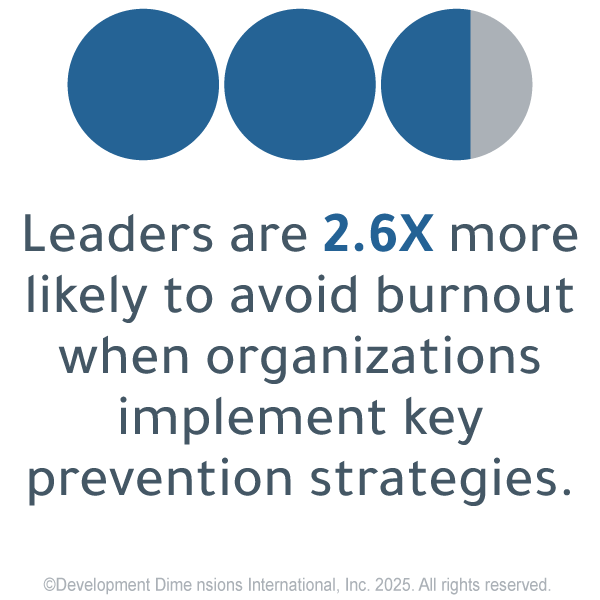
The numbers tell a powerful story. When these five strategies are in play, leaders are:
- 2.6X more likely to avoid burnout.
- 37.5X more likely to stay engaged.
- 18.5X more likely to enjoy leading.
- 11.8X more likely to remain with the company.
These results show why it’s crucial to prevent burnout. When companies invest in these areas, they build stronger teams and gain lasting advantages.
The message is clear: leader burnout can be prevented. When organizations focus on these proven strategies, they create places where leaders can thrive. This creates healthier leaders who stay longer, give more, and truly enjoy guiding others. And that’s essential to building a resilient, high-performing organization that thrives for years to come.
Have a Question?
Frequently Asked Questions About Preventing Burnout in Leaders
-
What are the signs of leadership burnout?

Signs of leadership burnout include chronic exhaustion, cynicism toward work, and a reduced sense of personal accomplishment. Leaders experiencing burnout may withdraw from their teams, have difficulty making decisions, and feel emotionally drained by everyday tasks. DDI’s leadership insights highlight these key warning signs as critical indicators that action is needed.
-
How can leaders prevent burnout among their teams?
According to DDI’s leadership development programs, leaders can prevent burnout by setting clear priorities, providing emotional support, encouraging open conversations about workload, recognizing contributions, and modeling a healthy work-life balance. Empowering teams and building emotional connections are essential skills that DDI emphasizes to help leaders maintain resilience across their organizations.
-
What strategies can organizations use to support burned-out employees?
DDI recommends that organizations support burned-out employees by building a culture of trust, investing in leadership development focused on emotional intelligence, offering flexible work arrangements, and providing coaching and mentorship opportunities. Through DDI’s leadership solutions, companies can equip leaders to identify stressors early and create sustainable environments for employee well-being.
-
How does DDI help companies address leadership burnout?
DDI helps companies address leadership burnout by delivering leadership development programs that strengthen emotional intelligence, resilience, coaching skills, and the ability to prioritize strategically. DDI’s proven leadership training solutions empower leaders to support their teams effectively while safeguarding their own mental health, ultimately creating more resilient, high-performing organizations.
Learn more about burnout in the Global Leadership Forecast 2025.